A WORD FOR JOHN SYKES

RIP TO THE GUITAR TONE THAT DEFINED A COMMERCIAL ROCK COLOSSUS

Some guitarists take us home.

They might not be the ones we listen to the most, we might not even have played them for years – but they’ve been in our lives the longest, on those played-to-death records from formative teenage years. That kind of exposure doesn’t just vanish, no matter how cutting edge we think we are. It’s hardwired into the unconscious. Play that music again and the strength of connection hits hard, sometimes unexpectedly so. It takes you into yourself and, crucially, back to yourself.

Home.

And this is why the news of John Sykes passing away – cancer, age 65 – is hard to take.

1987 was an album I played the life out of as a 14 year-old. The ballads were tolerated (no skipping with the record/tape format) and the keyboards mostly stank but the monstrous stop-start attack of Still of the Night was, and still is, a hard rock thrill for all time. Same for Crying in the Rain and deep-cut favourite, Children of the Night. And the thing that made the best of that album sound the way it did – the speeding rhythmic riffing, the shred-melodic solos and incomparable guitar tone – was John Sykes. He WAS 1987. His sound defined it and mega millions got sold on the back of period piece (cough) videos he never appeared in. Sykes has an exalted place in 80s rock history.

Credibility-wise, Whitesnake get short shrift – no surprise. For me, they were an adolescent band of a moment, but that moment put John Sykes out there. When his Blue Murder debut came out in 1989, firing out all the best bits of 1987 and far fewer of the worst bits, that album got played to death too – until the 90s took hold and both records got ditched without sentimentality as hair rock relics.

Wrong move.

You can’t shake that stuff. Many years later, realising that I needed that Sykes attack close to hand, I repurchased 1987 and Blue Murder. And in the past few years, I’ve been keeping gentle tabs on John Sykes activity – which is another reason why his passing away last week shocks.

There always seems to have been the promise of new music and a return to business. Fans were well up for it. Interviews with Tony Franklin and Carmine Appice said they’d been touch with him and the door was open so the rumblings were positive. Sykes himself said in 2019 that he had stuff ready to go … and each year passed by without. So everyone waited for further word, hopeful that one day something would appear.

A Carmine Appice interview published on YouTube in 2024 threw out the same Blue Murder question but where there was optimism before, now there was resignation. Appice said, “John…. know no-one knows what he’s doing.”

All too sadly now, I think we can guess.

So, this week has seen many riffs raised to a guy who made some of the best and made it all look so easy. Great singer too, the complete hard rock package. Watch the live version of Billy by Blue Murder on The Big Al Show – link below – from 1989 (?) and see. It comes with a Mullet Warning but the music and the performance is astonishing. The whole band smokes, every beat and note. And how Sykes sings, plays and peels off a screaming solo so effortlessly is something else. Favourite bit? Possibly the super-tight post-pause riff that explodes into the first solo. Or the casual intro.

Actually, all of it.

He was missed when he was alive. What more can you say now?

Not much, really. Better just pick a track, riff or solo, celebrate the gift of Sykes – and share it.

Some Sykes clips:
Thin Lizzy, Cold Sweat – The Tube, 1983
Whitesnake, Children of the Night audio, 1987
Blue Murder, Billy – The Big Al Show
John Sykes, Dawn of a Brand New Day, 2021

Blue Murder - Blue Murder
Blue Murder repurchased

MUSIC FOR CAT & FIDDLE 3: Catherine Graindorge & Iggy Pop

CATHERINE GRAINDORGE – THE DICTATOR EP

Storm Darragh made this drive a wild one. Moors and skies packed with portent – a glove-like fit for The Dictator.

Everyone knows Iggy has a voice for the spoken word. You hear it with Death in Vegas on Aisha. You hear it on Avenue B with She Called Me Daddy. You hear it every week on BBC 6 Music, grizzled as hell but warm as hell too, inviting you in hearth-side for anecdotes and insights on music. It’s a voice to sink into. And here, set to music that follows the contours of the peaks outside, it’s a voice to feed your imagination.

The music is far from Iggy’s riotous past, though not unexpected given his later output. Belgian violinist and composer Catherine Graindorge is the visionary, crafting four tracks of string-driven moods, shimmering electronics and haunting atmospherics. No percussion, no signposted beats – just surges, pulses, drifts and searing trails of light. Iggy relays poetic warnings in The Dictator, then takes an introspective turn on Mud I and Mud II:

I walk along the river
in a thick fog.
You tell me about a book your father once gave you.
In my head turns this melody – no words.
And you read me a princess story
from a distance.

Pop’s words with Graindorge’s soundscapes? WIN. The instrumental last track of the EP, named Iggy in honour of the voice, echoes the violin-bow taps Jimmy Page did on Dazed and Confused live but here the mood is ethereal, not theatrical … a foundation for a symphonic swell which, like everything else, matches the land and the season.

Storm Darragh meets The Dictator

Try it. Add this EP to your cold weather listens, maybe even pair it up with Neil Young’s Dead Man soundtrack – and not just for the Pop connection. There’s a rustic, earthy spirit running through both.

More Music for Cat and Fiddle

MUSIC FOR CAT & FIDDLE 2: Low

LOW – HEY WHAT

F*CK. ME. This is it.

Then again: it’s Low so what do we expect? And when do you listen to Low?

They’re a band I can’t play any time or too often because they’re just too intense, too special – especially those last two albums. Low seem to have a direct line to something way deeper than the rest of us. After pressing play on Hey What in the car, I become aware that the opening track White Horses builds in noise and distortion completely in sync with the incline and the gradually emerging, slowly unfolding landscape. Urbanity receding, wild moors welcoming. Beautiful. No, more than that: awesome. This happens to be an ultimate convergence of emotive music and scenery.

But if that wasn’t enough – and it would have been, easily – there’s a divine intervention from the goddess of good timing. White Horses hits peak distortion and noise saturation around 2 minutes 15 seconds – the exact moment a turn round a blind bend reveals the top of the world in full, unending glory.

Breath taken? Damn right. The combination of sound and vision is huge, which explains the F bomb earlier. Rendered speechless.

Low’s fragmented, techno-glitch density opens portals to a parallel universe. But the effect that comes from wrapping their fragile/euphoric harmonising within and around such sonic manipulation is unfathomable and unexplainable. It’s why Hey What and Double Negative transcend so much other music. It’s electro-noise gospel. Those albums just cannot be played in casual conditions that lessen the mystique. They need to be played with intent: night darkness with volume cranked, wild walks in storm force gales, the deepest of snows and winter freezes

or a moody overcast drive on the Cat and Fiddle.

More Music for Cat and Fiddle here.

MUSIC FOR CAT & FIDDLE 1: Robert Plant & Alison Krauss

PLANT | KRAUSS – Raise the Roof

Entry #1 of Music for Cat and Fiddle scenic soundtracks … and there’s something about the Robert Plant/Alison Krauss pairing, and Raise the Roof especially, that really lifts in this kind of space.

Which is no surprise given the general love/unfettered worship of all things Plant that I’ve been carrying forever, but even allowing for such fanatical tendencies, there are times of year when his music touches even higher levels. The Carry Fire album begs for a misty autumn or winter morning – play it one day when you’re up before the rest of the world awakes and tell me it doesn’t belong right there in that cool, quiet, open-to-reflection moment. Raise the Roof carries a similar torch for dawns and dusks and half lights, to my mind. Darker in tone than the also excellent Raising Sand, it’s tailored for the barren beauty of the Cat and Fiddle road drive

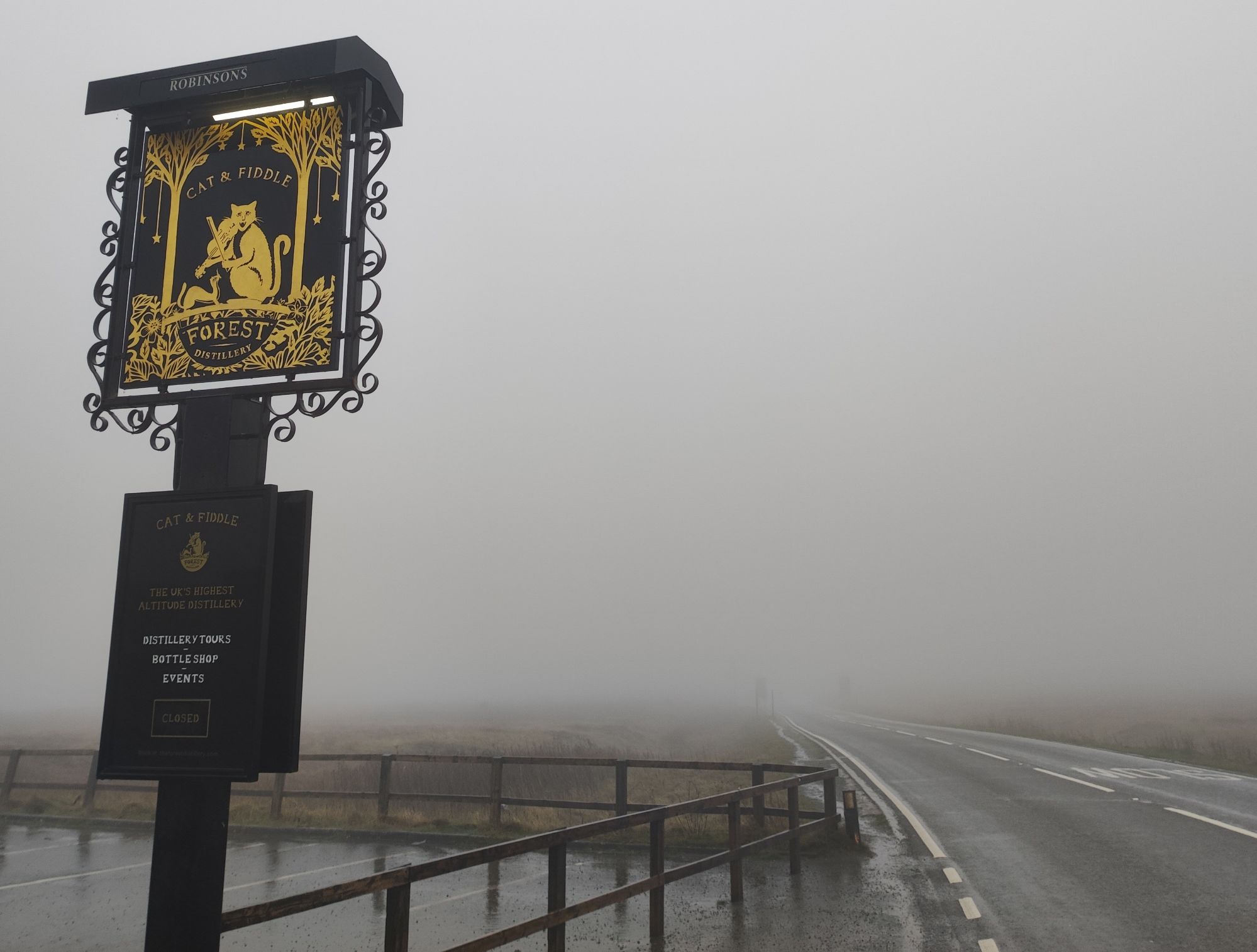
even when you can’t see shit:

Cat and Fiddle fog all around

And it’s those opening two tracks that do the business here. The gentle desert shuffle of Quattro (World Drifts In) reveals an existential reckoning while The Price of Love slows the beat to countrified lilt dripping with lyrical truths of love ended. You don’t need to know the Calexico and Everly Brothers originals to feel something but, as we said with Midwife, dusty Americana works in conditions that elevate the remote. It’s the very opposite of urban. And in the hands of Plant and Krauss, these songs touch on the devotional. They did for this drive.

But I guess I would say that.

[if you missed the link above or are just confused by the music words and fog picture combo you fell into, here’s the background to this music-as-soundtrack thread]

MUSIC FOR CAT AND FIDDLE

WINTER SOUNDS FOR PEAK DISTRICT DRIVES

What do you do when a new 30-minute drive to work takes you through scenery so epic, vast, bleak and beautiful that it threatens to melt your opticals and steal your oxygen?

Try not to career off the road on a hairpin bend is the first thing, I guess – ultimate life-preserver move.

But before long, you get to thinking: what music could be the soundtrack to this?

It’s got to be more than something you like. It’s got to be something you love AND it’s got to fit – it has to be deserving of the jaw-drop views from behind this widescreen windscreen lens. Anything less would be a disservice to the gift outside.

This has been my nicely indulgent task on a new but short term drive to work. Having just moved to Buxton and got a temp role through December, my drives took me on Macclesfield Road, aka the Cat and Fiddle road.

It is spectacular. The road climbs into the official Peak District and splits the moors 1,689 feet above sea level by the Cat and Fiddle Inn, a former pub that’s the second highest in the UK. The highest is Tan Hill Inn in North Yorkshire who, at the time of writing, was caught in a snow-in.

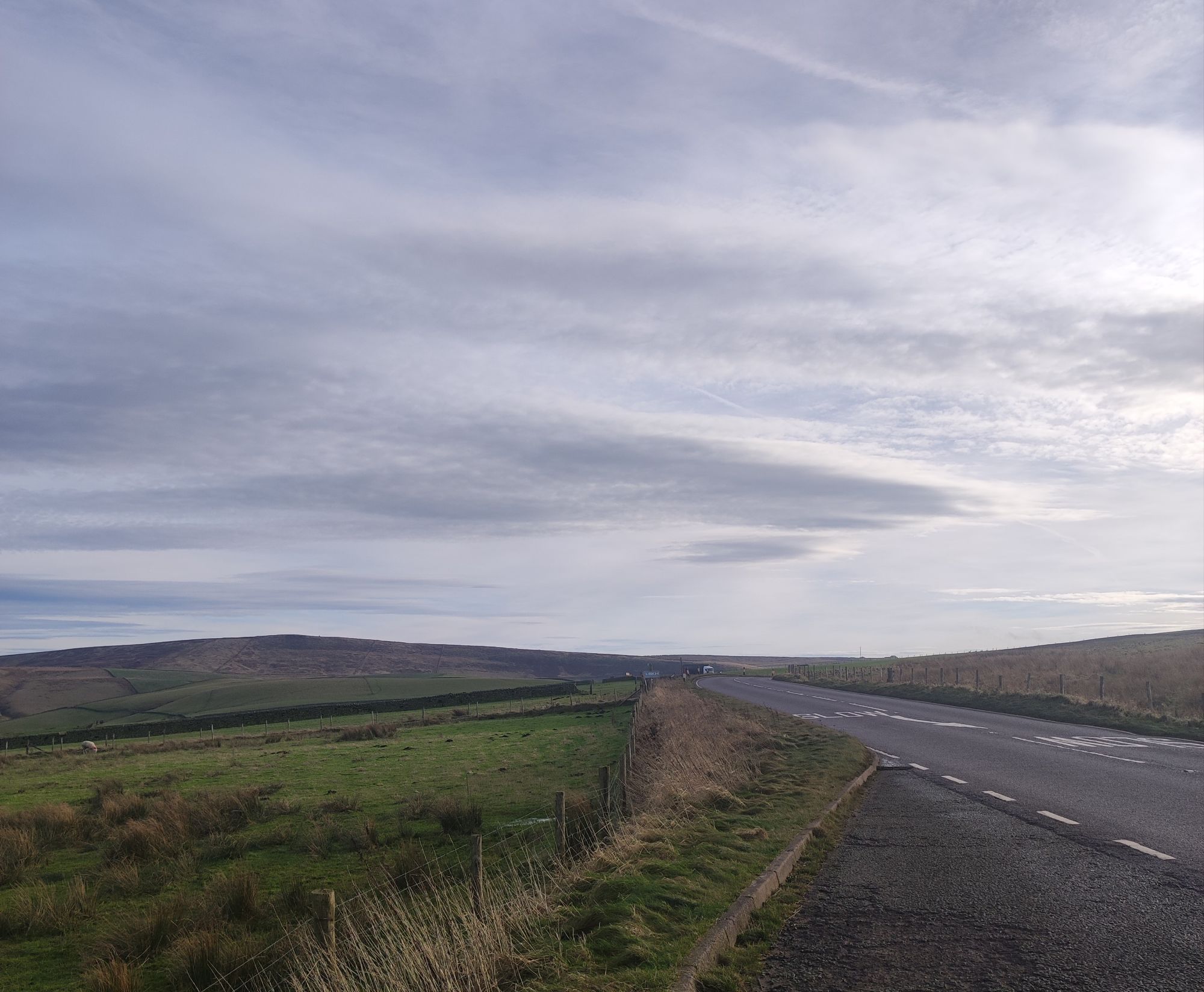
The road then carves a winding, hair-pinning zig-zag descent to Macclesfield on the other side. The moors are vast in their brown-purple haze. Dense fog is common, even when it’s clear down below. When adverse weather moves in, the road quickly becomes impassable. It’s been closed across the last three days since snow moved in on January 4th.

Fortunately, my drives didn’t encounter any snow beyond an occasional light flurry but joining that road at 5.20 am in the pitch black dark is a little bit of a test. All you can do is lean forward, follow the dots and block out the drops to the side. When there’s fog, it’s milk. Tunnel vision. For this, there is no music. Got to focus.

But the return journey a few hours later is different. Music becomes a possibility so … what’s it going to be? Melvins and Metallica might well be massive favourites but such riff-heavy, beat-driven manna is not going to be on the cards, not for this – not yet, anyway. The newness of the views and shifting natural lights is too fresh. We’re looking for an emotional, more than a physical, response from our tunes. Something to swell hearts.

It’s a time/place thing, too. If you’ve ever chosen not to play, say, David Bowie’s Low because it’s the wrong time of the day or the wrong time of the year then you know what we’re talking about here. Some music has conditions attached, even if you’ve made them up yourself. And some environments have conditions too. This is one of them.

So, the next few posts are short rambles about music that matches up to the mother of mid-winter views. See what you think of their seasonal potential.

A clear view – but for how long?